Kitchen sponge or dish brush: which is cleaner?
Short answer: the brush. It drains, it dries, and bacteria do badly in it. A sponge still has its jobs, as long as you clean it with heat and replace it often.
On this page
The dish brush is the more hygienic of the two, according to a 2021 study. In the lab, brushes dried fastest and bacteria died off in them, while bacteria survived or grew in sponges. A sponge stays damp, it is full of small holes, and it spends its life wiping up food. That is a comfortable place for bacteria.
A 2017 study in Scientific Reports looked inside 14 used kitchen sponges from households in Germany and found bacteria throughout them, concentrated in the internal cavities and on the surfaces, at local densities of up to 54 billion cells per cubic centimetre.
What happens in a brush instead
The most direct comparison comes from a 2021 study in the International Journal of Food Microbiology. The researchers surveyed 9,966 people in ten European countries about how they wash up, then tested how bacteria grow and survive in sponges and brushes in the lab.
Brushes dried fastest. In sponges, Salmonella survived for more than seven days in two of the three types tested, and bacteria that don't cause illness multiplied to high levels. In the brushes, all the bacteria died off over time: Campylobacter dropped below the level the test could detect within one day, and Salmonella within three. The authors concluded that brushes are more hygienic than sponges and that their use should be encouraged.
That doesn't make sponges useless. Some jobs suit something soft, like the inside of a glass, or a non-stick pan, where Tefal, which makes non-stick cookware, names a nylon sponge as ideal. It just means a sponge needs looking after and replacing, and a brush needs the same care after raw food spills.
If you keep a sponge
Clean it with heat
In 2007 the USDA's Agricultural Research Service tested common ways of cleaning a heavily contaminated sponge. Soaking it in a 10 per cent bleach solution, in lemon juice or in plain water killed 37 to 87 per cent of the bacteria, the same range as sponges left untreated, which left enough to potentially cause illness. One minute in the microwave killed 99.99999 per cent. A run through the dishwasher with a drying cycle killed 99.9998 per cent.
The 2021 study found chlorine, boiling and the dishwasher all reduced Salmonella, so results vary by method and test. The dishwasher is the one method that worked in both the USDA test and the 2021 study.
If you use the microwave, do it safely. A University of Florida note on microwaving sponges gives three warnings: the sponge must be completely wet, to guard against fire; it must have no metal in it; and it comes out hot, so take care lifting it out.
Replace it often
Heat killed most bacteria in the USDA's lab test, but cleaning may not last. In the 2017 study, the sponges their owners said they cleaned regularly (by microwave or hot, soapy water) did not have fewer bacteria, and had higher shares of two types of bacteria closely related to species that can cause disease. The researchers suggested replacing kitchen sponges regularly instead, for example once a week. The 2021 study adds a simple rule: replace or clean a sponge or brush whenever it may have touched something risky, such as spills from raw food.
Keep it off wiping duty
For wiping down kitchen surfaces, the USDA suggests considering paper towels, and if you use dishcloths, washing them often on the hot cycle of the washing machine. A sponge that has mopped up raw chicken juice is the case the 2021 study says to clean or replace.
Which brush for which job
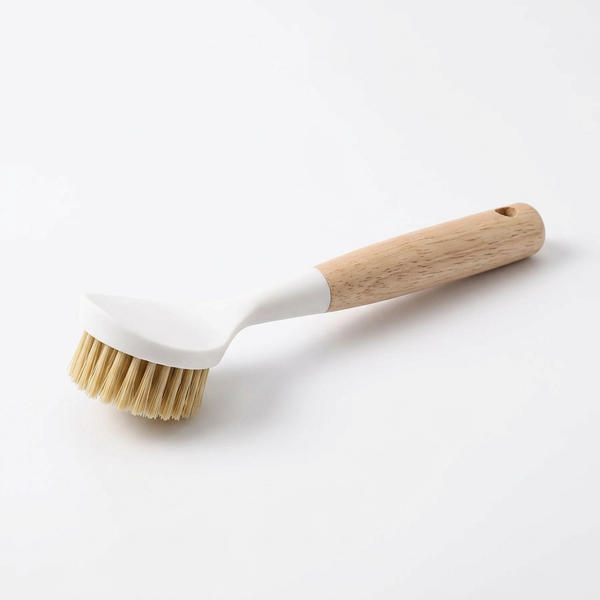
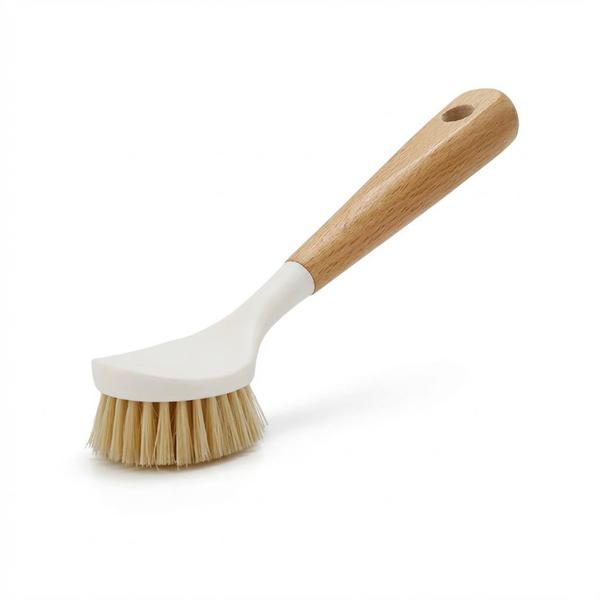
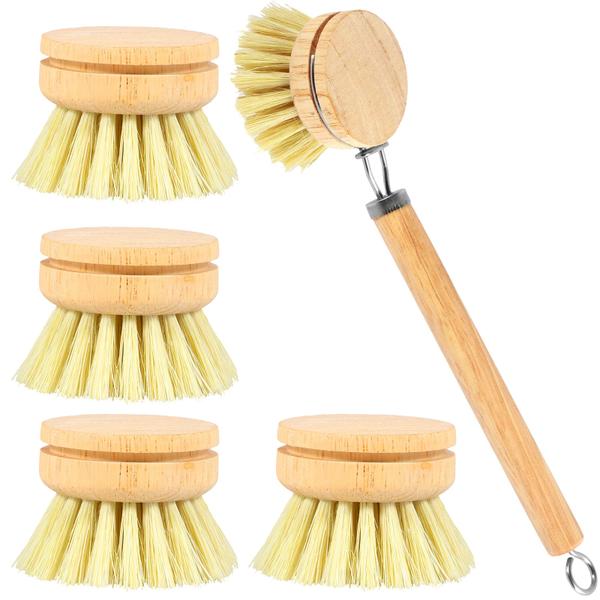
Everyday plates and pans. The wood handle dish brush has firm bristles and a compact head that gets into corners, and its page names cast iron and frying pans among its jobs. The bamboo dish scrub brushes come in sets that the page describes as 3, 4, 5 or 10 brushes, with long wooden handles and heads the page says are replaceable. Both have wooden handles, and our care page says wood and bamboo are hand-wash only, never the dishwasher. Rinse them, shake them out and stand them to dry, bristles down where you can.
On seasoned cast iron, a little mild dishwashing liquid is fine. Lodge, the cast iron maker, calls the no-soap rule a myth. What matters is drying the pan promptly and finishing with a light layer of cooking oil.
Pots, pans and stovetops. The long handle dish brush is about 28 to 30 cm with nylon bristles. It has a hanging handle, so it can dry on a hook instead of sitting in a puddle.
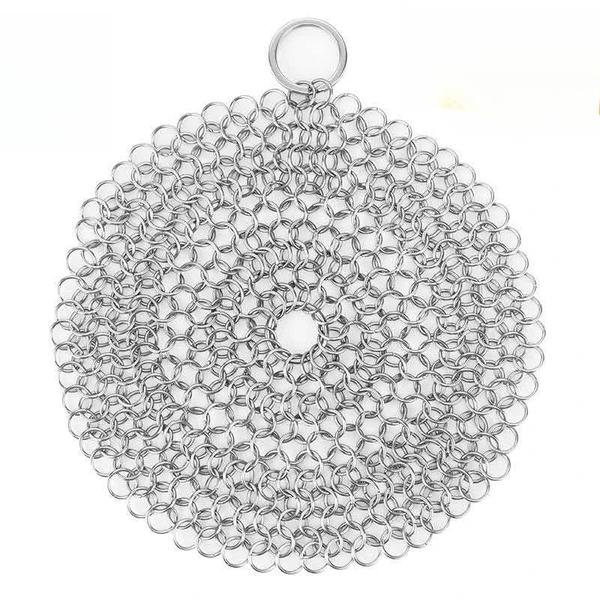
Stuck-on food and grease. The stainless steel pot scrubber is a handheld scrubber of 316L steel coils, for pots, pans and grills. It is also the one to keep off delicate or non-scratch surfaces, as its own page says. Tefal says scouring pads are not suitable for non-stick pans, and that is one job where the sponge earns its place.
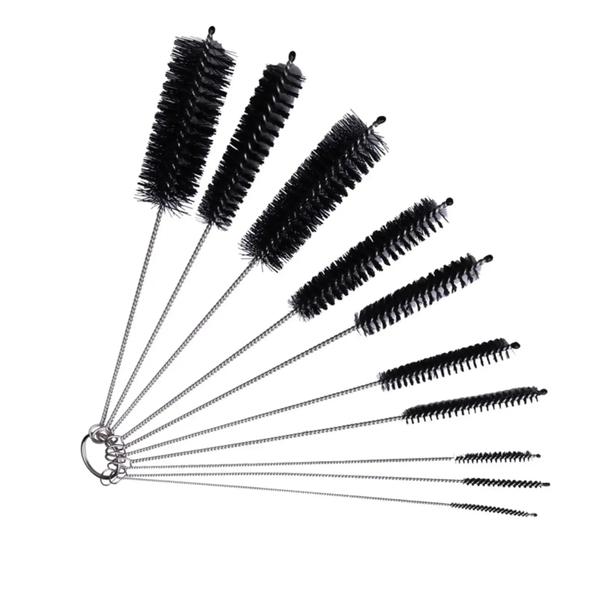
Spouts, straws and narrow necks. The pipe tube brushes come ten to a pack, about 20 cm long, with nylon bristles on a stainless steel handle. Their page says they are made for bottles, teapots, kettles, narrow tubes, spouts and straws.
Let everything dry
Brushes dried fastest in the 2021 study, and bacteria died off in them. In the type of sponge that dried slowest, Salmonella actually grew on the first day. A sponge left sitting wet in the sink dries slowly, so whatever you use, give it somewhere to drain.
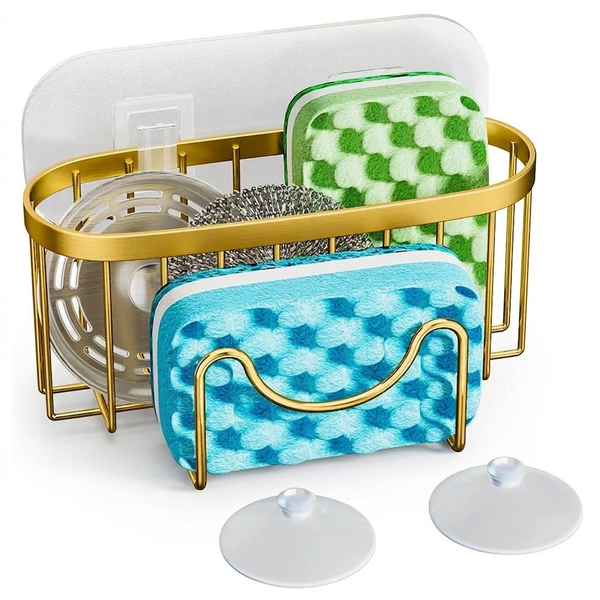
The stainless steel sponge holder fixes beside the sink with two suction cups, has an open, hollow design that its page says drains water faster, and has a built-in hook for extra hanging space. The page also asks you to fix the cups to a smooth, clean surface and to wash the holder regularly with mild soap.
The sponge rules, in short. Clean it with heat: a completely wet sponge in the microwave for one to two minutes (the USDA test used one, the University of Florida note says two), or the dishwasher with a drying cycle. Replace it often, weekly if you can, and clean or replace it straight away after raw food spills. Let it dry between uses, up off the bottom of the sink. And for most of the washing-up, use a brush.
Sources
- Møretrø et al., International Journal of Food Microbiology (2021): Dishwashing sponges and brushes, consumer practices and bacterial growth and survival
- Cardinale et al., Scientific Reports (2017): Microbiome analysis and confocal microscopy of used kitchen sponges
- USDA Agricultural Research Service (2007): Best ways to clean kitchen sponges
- University of Florida News (2007): Microwave sponges
- USDA FSIS: Cleanliness helps prevent foodborne illness
- Tefal: How to care for my Tefal cookware
- Lodge Cast Iron: 10 myths about cast iron cookware
About this guide. We sell the tools named here, and we’ve said where they aren’t the right choice. Product details come from each product’s own page. Food-safety and care points follow the sources above and are general guidance; where your appliance or pan came with its own instructions, those come first.